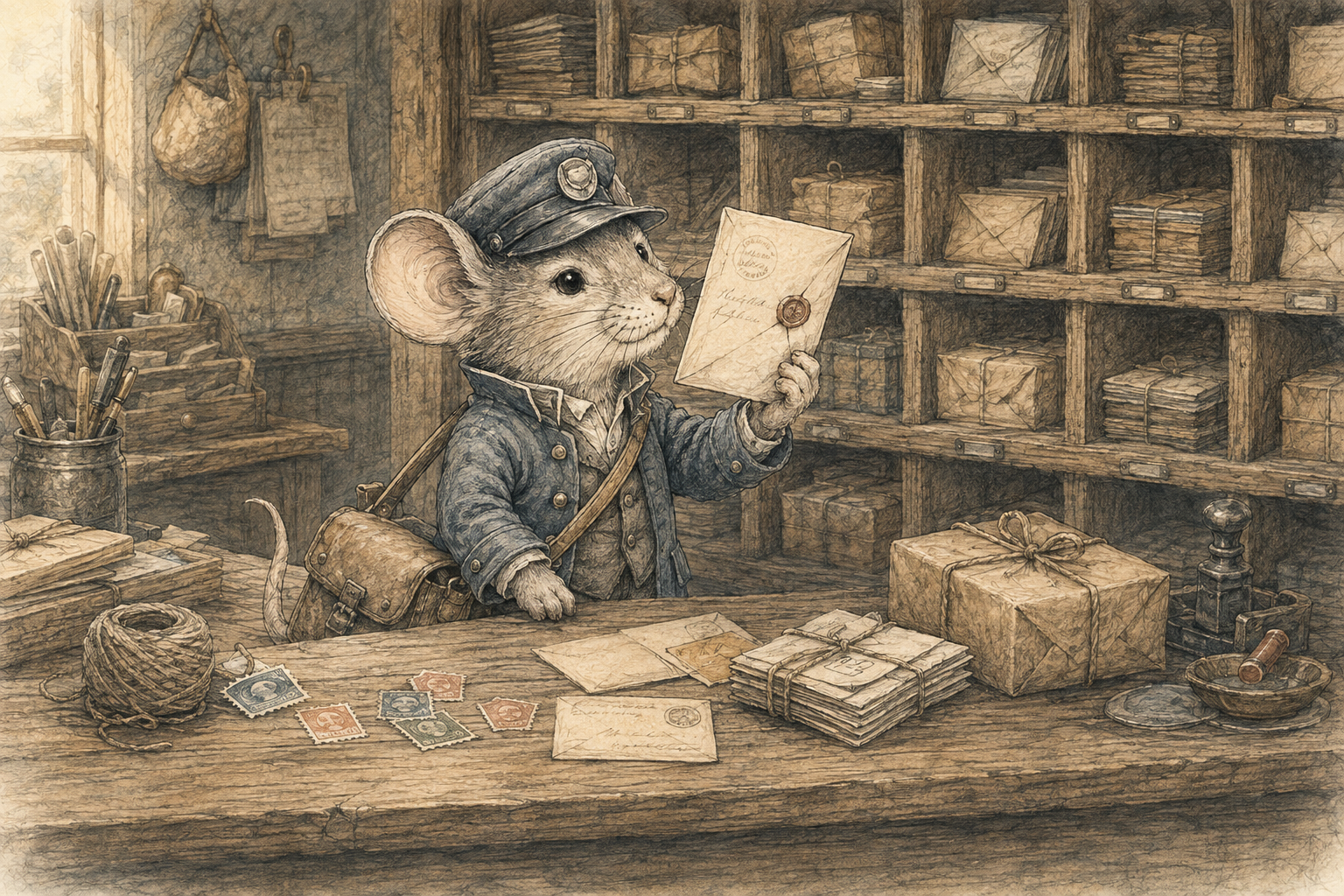
If you want to know what is happening in Riverpost, the post office is probably a good place to start.
Not because Marlowe Quickpaw gossips. He would be the first to object to that description. A postman simply notices things. It’s part of the job.
Every morning there are letters to sort, parcels to stack, addresses to puzzle over, and a mailbag to pack before he can set out along the Silverbend. Some mornings the work is just ordinary. Other mornings begin with an envelope addressed to someone Marlowe has never heard of, a package with no return name, or a note written in such a hurry that half the address seems to have been forgotten.
Those are the interesting mornings.
I have always liked old post offices, especially the small ones. There is something about all those little boxes, tied bundles, stamps, handwritten names, and letters waiting to go somewhere that makes you wonder about the stories traveling through the room.
That was what I wanted for the Riverpost Post Office.
Riverpost is a working little place with shelves, cubbyholes, sorting tables, stacks of envelopes, parcels wrapped in brown paper, and the usual collection of things that Marlowe insists he knows exactly where to find.
Most of the time, he does.
A letter may arrive from someone who hasn’t visited the Silverbend in years.
A parcel might come upriver for Barlow’s store.
Hestle may be waiting for a particular bit of correspondence about supplies.
Lutt might stop in with news from the docks before Marlowe has even finished sorting the morning mail.
Wrenna Reed rarely needs much of an excuse to appear when something unusual is happening.
Before long, a perfectly quiet morning can become rather crowded.
I imagine there are days when Marlowe barely has time to close one conversation before another neighbor appears at the door.
Of course, being the postman means he knows where nearly everyone lives.
That becomes surprisingly important.
He knows which path leads to which cottage, which families live beyond the bend, who has moved farther upriver, who receives regular letters, and who almost never receives anything at all.
So when something unfamiliar appears among the morning post, Marlowe pays attention.
Perhaps it is a name he doesn’t recognize, or the handwriting looks familiar but the sender’s name does not. Perhaps a parcel feels much too light for its size.
There might even be a letter addressed simply:
I think Marlowe would sigh at that one.
He would deliver it, naturally.
Still, he would probably sigh first.
The post office gives me a wonderful place to imagine all sorts of small beginnings for future adventures, because letters are curious things. They can bring good news, bad news, invitations, warnings, apologies, instructions, secrets, or messages someone hoped would never be read by the wrong person.
A parcel can be even more suspicious.
Nobody wonders much about a neatly addressed letter.
Put a strangely shaped package on the counter with no sender’s name, though, and suddenly everyone in Riverpost seems to have an opinion.
That is part of the fun of this little world for me. The mysteries don’t always have to begin with something dramatic. Sometimes all it takes is one ordinary object appearing where it shouldn’t.
A letter.
A key.
A bit of string tied in an unusual knot.
A parcel that nobody remembers ordering.
Marlowe’s work puts those little mysteries directly into his paws.
There is another reason I like the post office so much.
Marlowe’s job gives him a perfectly natural reason to know Riverpost. He isn’t wandering around looking for trouble. He has work to do. He has letters to deliver and people depending on him.
Trouble simply has an unfortunate habit of appearing somewhere along the route.
By the end of the day, the sorting table may finally be empty. The last parcel has been delivered, the mailboat is tied up, and Marlowe can hang his bag on the hook for the night.
Tomorrow morning there will be another bundle waiting.
Another ordinary day, but not always!
At least, that is what Marlowe will be hoping.