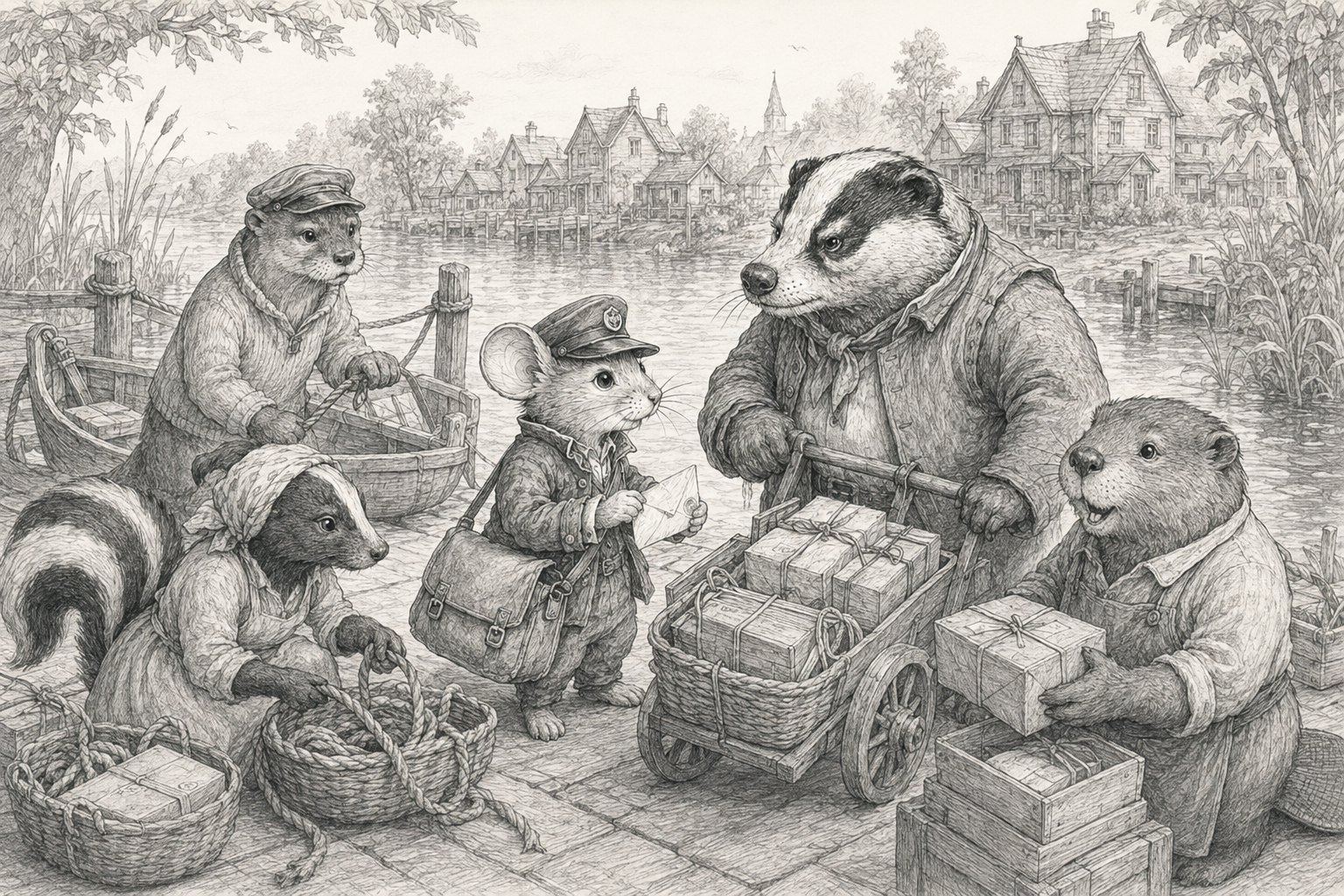
Marlowe Quickpaw may carry the mail through Riverpost, but he certainly does not keep the little river settlement running by himself.
Riverpost is the sort of place where everyone has something to do.
Boats need tending. Rope must be made and mended. Goods arrive at the store. Messages travel up and down the river. Someone always seems to need a hand with a loose shutter, a missing parcel, a troublesome knot, or a question that can’t wait until tomorrow.
But, every so often, there is a mystery.
When I first began imagining Riverpost, I didn’t want it to feel like a collection of characters placed around Marlowe simply because a story needed them. I wanted it to feel like a real little community, the kind of place where everyone has a purpose and where one creature’s work naturally crosses paths with another’s.
That is how Marlowe’s friends began to find their places.
There is Wrenna Reed, the kingfisher, bright-eyed and observant, with the wonderful advantage of being able to see Riverpost from above as well as from the riverbank. Wrenna is the sort of friend a postman needs when his ordinary rounds begin leading somewhere unexpected.
At the docks there is Lutt, Riverpost’s dock master, a stout river otter who knows the boats, the landings, and much of what passes along the water. A dock master is bound to hear things. Boats come in, and go out. Travelers stop for a while, cargo is unloaded, and conversations have a habit of drifting farther than the people having them intended.
Then there is Hestle, the skunk weaver.
Hestle works with rope, cord, and the practical things Riverpost depends upon every day. I like the idea that an old-fashioned river community would still have craftspeople whose work mattered. Nothing arrives overnight in a cardboard box. If something breaks, somebody repairs it. If rope is needed, somebody makes it. If a boat must be tied securely before a storm, everyone knows whose work they are trusting.
Barlow the beaver keeps the store, which makes him another important part of Riverpost life. A village store is never only a place to buy things. It is where people stop, talk, hear what has happened, wonder what might happen next, and occasionally learn something they were probably not supposed to know.
There are others too.
Grufford the badger. Grindle the raccoon. The residents and visitors who make their way through Riverpost, each with their own habits, occupations, suspicions, and stories.
Some may know more than they first admit, which becomes rather useful in a mystery.
What I enjoy most about these characters, though, is not simply the part they play in solving one particular puzzle. It is the idea that their lives continue even when Marlowe is not standing beside them.
Hestle still has rope to weave.
Lutt still watches the docks.
Barlow still opens his store.
Wrenna still flies over the river and settles somewhere above the reeds where she can keep an eye on things.
Marlowe still sorts the post and begins another day’s route.
That is what makes Riverpost feel alive to me.
In the natural world, every creature has its own business. That was one of the things I noticed during all those years spent sitting behind a camera. A bird didn’t appear simply because I was waiting to photograph it. It had somewhere to go. Something to gather. A nest to tend. A territory to defend. A meal to find.
The creature had a life entirely apart from me.
I wanted Riverpost to have that same feeling.
Its inhabitants are not waiting around for a mystery to begin. They are already busy living there. The mystery simply arrives in the middle of it.
When it does, Marlowe has something far more useful than a magnifying glass or a detective’s badge.
He has neighbors.
He has craftspeople who know their work, friends who notice things, shopkeepers who hear things, river folk who understand the water, and a community where even the smallest observation might matter.
Because in Riverpost, mysteries may belong to Marlowe Quickpaw.
But solving them is very often a neighborhood affair.