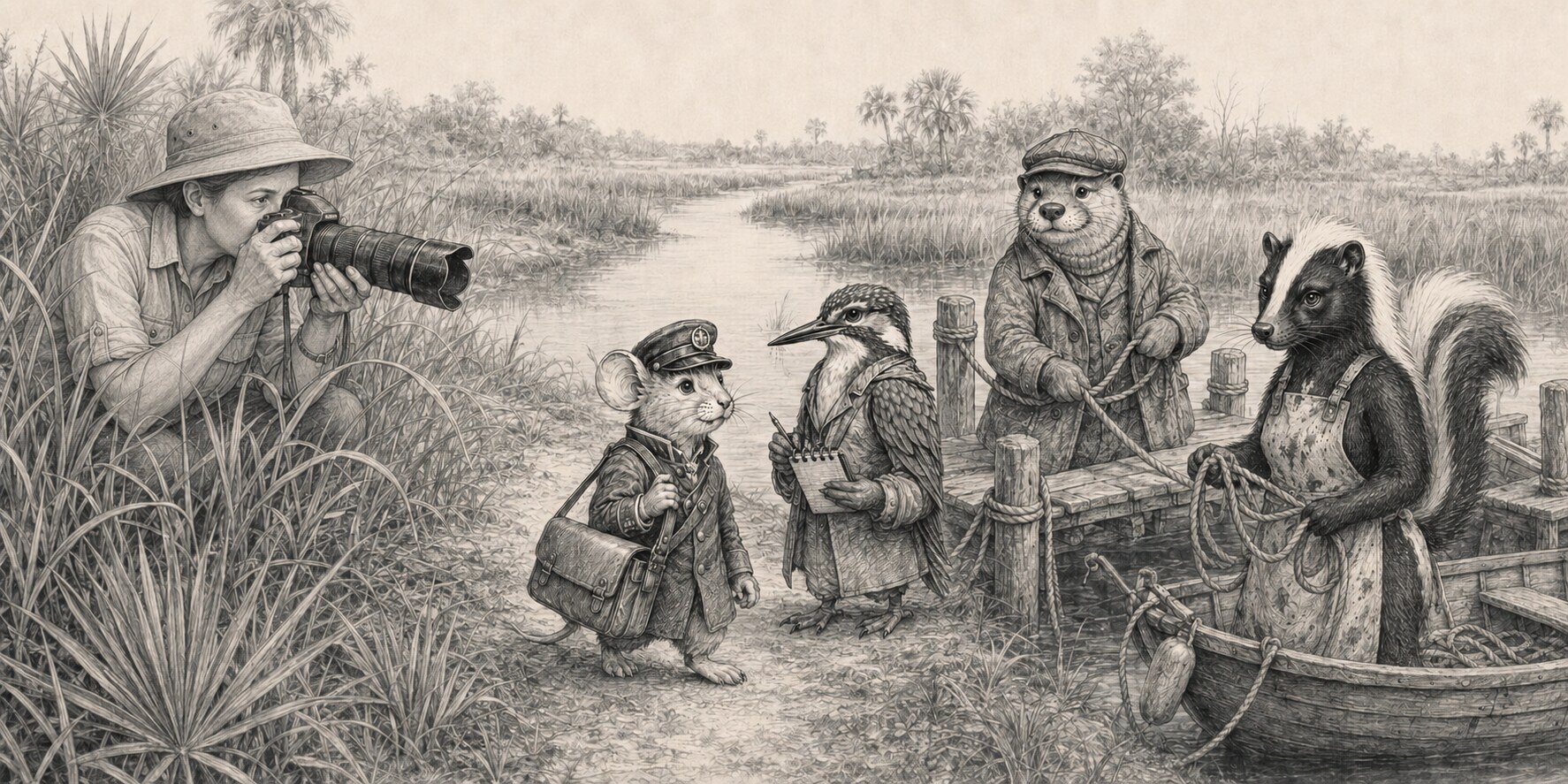
Long before Marlowe Quickpaw ever carried a mailbag or set out along the Silverbend, there was a marsh, a camera, and a great deal of waiting.
The idea for this series began years ago while I was sitting quietly with my camera and a long lens, waiting for the right shots of the Spoonbills and Storks I had been photographing and watching the creatures that lived around the bogs, creeks, and tall marsh grass. Wildlife photography involves a surprising amount of stillness. You find a place to settle in, try not to disturb anything, and wait for the ordinary business of the wild world to begin again.
And it always does.
A bird returns to the same perch. A raccoon disappears along the water’s edge. A beaver goes about some private construction project. Something rustles beneath the grass, and creatures come and go as though they have appointments to keep and jobs that can’t possibly wait a moment longer.
After a while, I began wondering what all that activity might look like if there were another little world hidden inside the one I was photographing.
Perhaps there was a postman making his rounds somewhere beyond the reeds.
Perhaps someone repaired boats along the creek, and another creature that kept a shop, wove rope, delivered messages, worried about the weather, knew everyone else’s business, or noticed when something in the neighborhood was not quite right.
That was how the beginnings of the Marlowe Quickpaw world quietly took shape.
The names of the creatures began popping in my imagination here and there, sometimes while I was outside and sometimes later in the evening when I was looking through the photographs I had made that day. Every now and then I would stop at an image because there was something about the animal’s expression or posture that suggested a personality.
Before long I was making notes of all the little observations, names, possibilities, and pieces of an adventure that seemed to be waiting for me to take notice.
Eventually one of those characters became Marlowe Quickpaw, a mouse with a mailbag, a dependable route, and a tendency to find himself much closer to a mystery than an ordinary postman might prefer.
The Silverbend became the place where all those imagined paths, waterways, houses, shops, bridges, and creatures could belong.
That is one of the things I have always loved about watching wildlife. The longer you sit quietly, the less empty a place becomes. A marsh that looks still from a distance is anything but still when you spend time inside it. There are territories, routines, disagreements, partnerships, warnings, meals, construction projects, narrow escapes, and endless comings and goings.
It already contains the beginnings of a story.
The Marlowe Quickpaw mysteries grew from that feeling.
The first adventure, The Shadow Over the Silverbend, takes readers into that little world at a moment when something has gone wrong. Marlowe begins where he usually does, carrying out his rounds, but familiar places and familiar faces soon begin to feel slightly different. A mystery is taking shape along the river, and Marlowe can’t help noticing the pieces that don’t quite fit.
I wanted the story to have the feeling of the old animal tales I loved, where the characters have homes, occupations, friendships, worries, and responsibilities of their own. But I also wanted a proper mystery running through it, something readers could follow and wonder about alongside Marlowe.
Although the books are written so children can enter the Silverbend and enjoy the adventure, I never thought of the world as belonging only to them.
I hope adults might enjoy visiting it too.
There is something pleasant about stepping for a little while into a place where a mouse delivers the post, a kingfisher has important things to say, an otter keeps watch along the docks, and every bend in the creek might conceal a clue.
Perhaps that is because the Silverbend began with something very real.
It began with sitting ever so quiet in a marsh, watching and waiting.
The animals were already busy with their lives.
I simply imagined the rest.